 ไทย
 English
 日本語
What Is Ceramic Fiber?
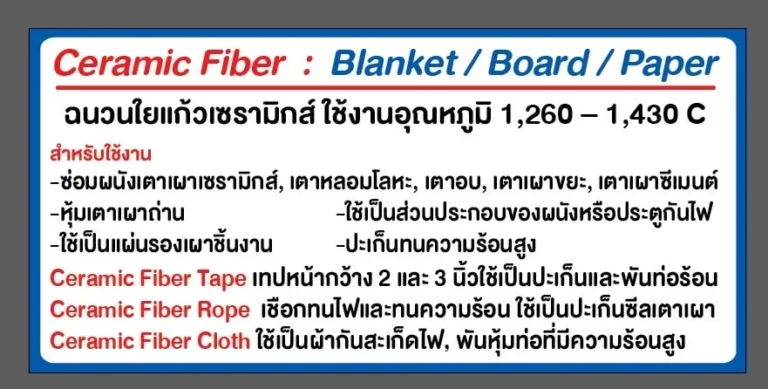
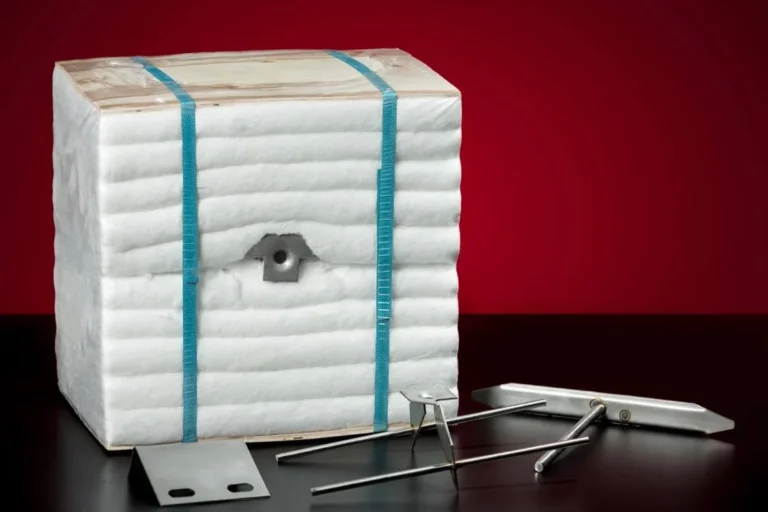
Ceramic fiber is a synthetic material made from ceramic raw materials — distinct from fiberglass in both material and structure. It is used as heat insulation in industrial furnaces, kilns, and heaters.
Product Forms
Full Specifications
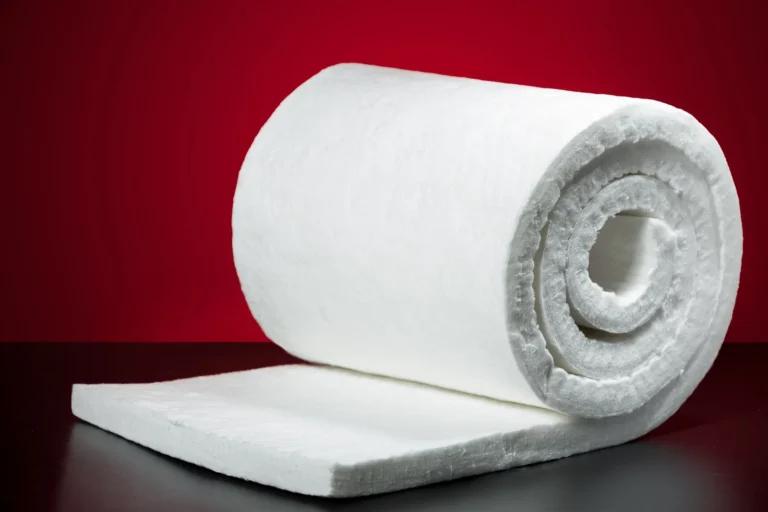
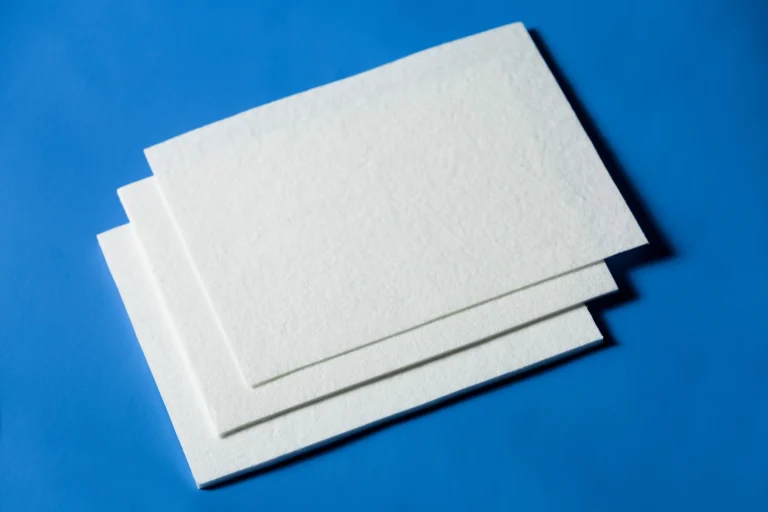
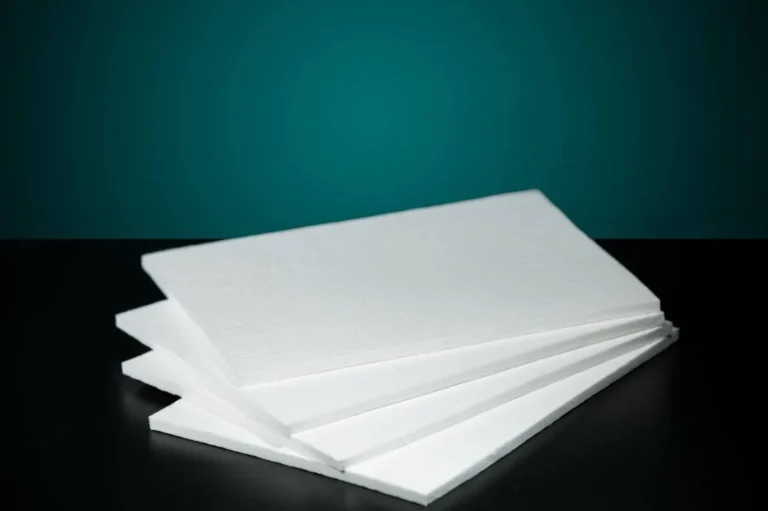
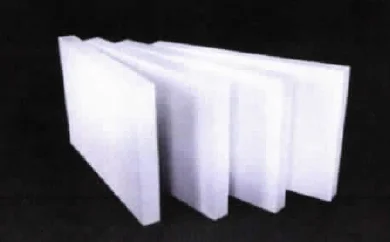
2. Board — rigid, more erosion-resistant than Blanket, rated 1,260°C and 1,430°C, sizes 900×600×25 and 900×600×50 mm.
3. Paper — thin, bendable, rated 1,260–1,430°C, thickness 1–6 mm, width 610 mm.
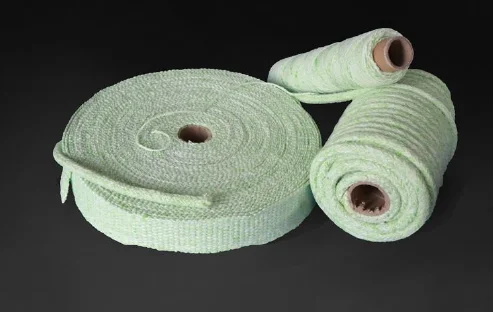
4. Tape — 3 mm thick, 50/75 mm wide, 30 m long, optional SUS304 wire reinforcement, rated to 1,000°C, density 500 kg/m³.
5. Rope — square or round braid with internal SUS304 wire, rated to 1,260°C, used for door seals and exhaust wrapping.
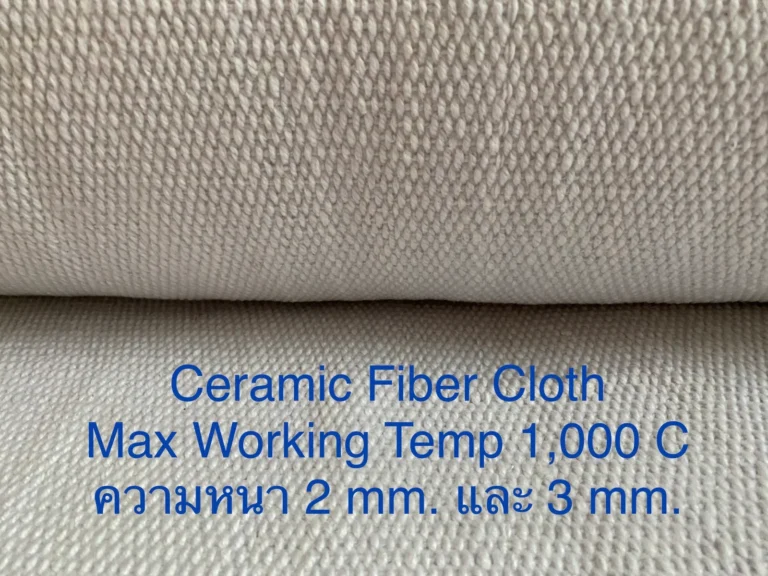
6. Cloth — 2×1,000 mm×30 m or 3×1,000 mm×20 m, SUS304 wire reinforced, density 500 kg/m³, rated to 1,260°C.
Fiberfrax Adhesive — Ceramic Fiber Adhesive
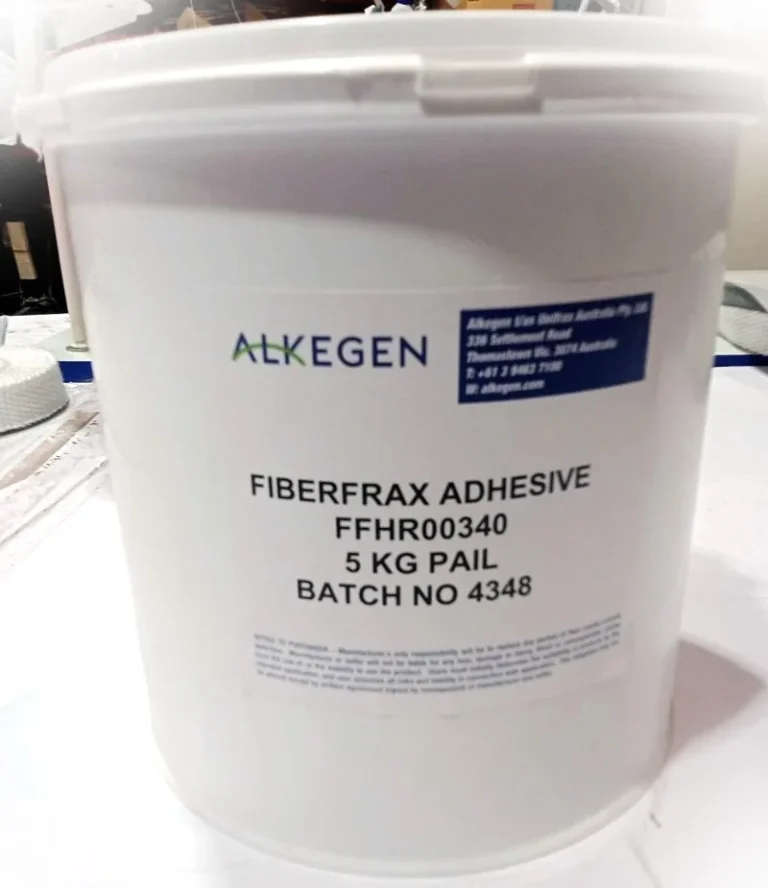
Fiberfrax Adhesive (product code FFHR00340 · 5 kg pail) is a ready-mixed compound for bonding ceramic fiber to brick or metal surfaces, and ceramic fiber to itself. It is used as supplied, with no water to add: a thick paste that dries quickly, bonds from 300°C upward and is rated for continuous service at 1,260–1,400°C.
Unifrax was renamed Alkegen on 24 January 2022; the product and its quality are unchanged.
- Environmentally friendly adhesive
- Bond strength increases with temperature
- Resists thermal shock
- Corrosion resistant
- Stable at high temperatures
Applications
Bonding ceramic fiber to brick walls or metal surfaces
Bonding ceramic fiber to ceramic fiber
Bonding gaskets of various shapes
Fiberfrax Adhesive Specifications
| Property | Value |
|---|---|
| Base material | Natural fiber |
| Color | Beige |
| Form | Thick mixed paste |
| Continuous service temperature | 1,260–1,400°C |
| Specific gravity | 1.52–1.58 |
| Application rate | 1 mm thick on both surfaces |
| Shrinkage | 0.5% at 800°C |
| Shelf life | 1 year |
| Al2O3 | 8–9% |
| SiO2 | 32–35% |
| Na2O | 6.9–7.2% |
| Other liquid components | 45% |
| Packaging | 5 kg pail (code FFHR00340) |
LUYANGWOOL® and BIOWOOL® Products
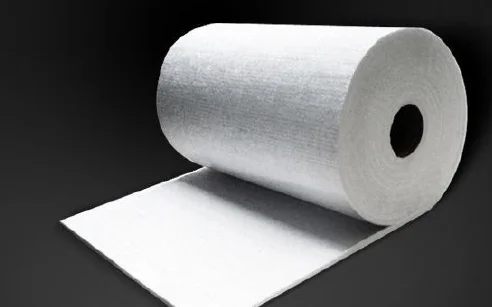
Ceramic Fiber Blanket — LUYANGWOOL®
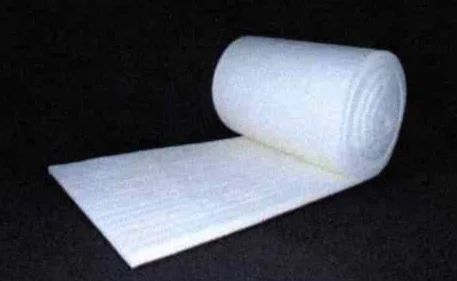
LUYANGWOOL® Blanket is a high-strength needled blanket made from LUYANGWOOL® bulk fiber. Long spun fibers and needling give a tough, resilient blanket that resists tearing before and after heating. It is fully inorganic and can be folded, compressed and encapsulated into modules.
- Excellent thermal shock resistance and thermal stability
- High tensile strength
- Low thermal conductivity and low heat storage
- Uses: pipe wrap, furnace and kiln back-up insulation, chimney insulation, annealing furnace linings, process heater linings
Ceramic Fiber Blanket Specifications (LUYANGWOOL®)
| Property | STD | HP | HA | HZ |
|---|---|---|---|---|
| Classification temperature (°C) | 1,260 | 1,260 | 1,350 | 1,430 |
| Al2O3 (%) | ≥ 43 | ≥ 44 | ≥ 52 | ≥ 35 |
| SiO2 (%) | ≥ 54 | ≥ 55 | ≥ 47 | ≥ 49 |
| ZrO2 (%) | – | – | – | ≥ 15 |
| Shot content (%) | ≤ 15 | ≤ 15 | ≤ 15 | ≤ 12 |
| Density (kg/m³) | 64 / 96 / 128 | 96 / 128 | 96 / 128 | 96 / 128 |
| Tensile strength (kPa) | 30 / 50 / 70 | 50 / 70 | 50 / 70 | 50 / 70 |
| Permanent linear shrinkage, 24 h | ≤ 2.5 % at 1,000°C | ≤ 2.5 % at 1,100°C | ≤ 3.0 % at 1,200°C | ≤ 3.0 % at 1,350°C |
| Thermal conductivity (W/m·K) at 200°C | 0.07 / 0.06 / 0.06 | 0.06 / 0.06 | 0.06 / 0.06 | 0.06 / 0.06 |
| Thermal conductivity (W/m·K) at 400°C | 0.12 / 0.11 / 0.10 | 0.11 / 0.10 | 0.11 / 0.10 | 0.11 / 0.10 |
| Thermal conductivity (W/m·K) at 600°C | 0.20 / 0.19 / 0.18 | 0.19 / 0.17 | 0.18 / 0.16 | 0.16 / 0.15 |
| Thermal conductivity (W/m·K) at 800°C | 0.30 / 0.23 / 0.20 | 0.23 / 0.20 | 0.22 / 0.20 | 0.21 / 0.19 |
| Thermal conductivity (W/m·K) at 1,000°C | 0.40 / 0.32 / 0.27 | 0.31 / 0.26 | 0.30 / 0.26 | 0.30 / 0.26 |
Ceramic Fiber Board — LUYANGWOOL®
LUYANGWOOL® Board is wet-formed from LUYANGWOOL® bulk fiber and binders, for linings that face vibration, mechanical stress and erosive forces. It helps cut energy costs and cycle times while protecting refractory surfaces from thermal shock and chemical attack.
- Easy to machine, cut and shape
- High rigidity with light weight
- Low thermal conductivity and low heat storage
- Uses: hot face lining in petrochemical furnaces and ceramic kilns, board-over-blanket hot face, back-up to brick and castable, expansion joints
Ceramic Fiber Board Specifications (LUYANGWOOL®)
| Property | STD | HP | HA | HZ |
|---|---|---|---|---|
| Classification temperature (°C) | 1,260 | 1,260 | 1,350 | 1,430 |
| Density (kg/m³) | 250 / 300 / 360 | 250 / 300 / 360 | 300 / 360 | 300 / 360 |
| Modulus of rupture (MPa) | ≥ 0.3 | ≥ 0.3 | ≥ 0.3 | ≥ 0.3 |
| Compressive strength at 10% deformation (MPa) | 0.15 / 0.25 / 0.3 | 0.25 / 0.3 | 0.25 / 0.3 | 0.25 / 0.3 |
| Loss on ignition (%) | ≤ 6 | ≤ 6 | ≤ 6 | ≤ 6 |
| Permanent linear shrinkage, 24 h | ≤ 3.0 % at 1,000°C | ≤ 3.0 % at 1,100°C | ≤ 3.5 % at 1,200°C | ≤ 3.5 % at 1,350°C |
| Thermal conductivity (W/m·K) at 400°C | 0.08 | 0.07 | 0.07 | 0.07 |
| Thermal conductivity (W/m·K) at 600°C | 0.11 | 0.10 | 0.10 | 0.09 |
| Thermal conductivity (W/m·K) at 800°C | 0.14 | 0.14 | 0.13 | 0.13 |
| Thermal conductivity (W/m·K) at 1,000°C | 0.19 | 0.19 | 0.19 | 0.18 |
BIOWOOL® Bio-Soluble Fiber
BIOWOOL® is made from soluble fiber and can meet the requirements of European Regulation (EC) No 1272/2008. It suits applications up to 1,100–1,300°C.
- BIOWOOL® Blanket — needled, 1,100°C and 1,300°C grades; pipe wrap, furnace back-up, annealing furnace linings, appliance insulation, expansion joint seals
- BIOWOOL® Textiles — cloth, tape, yarn and rope reinforced with glass filament (650°C continuous) or stainless steel wire (1,000°C); light green, organic content ≤ 18%; gaskets, furnace door seals, pipe insulation, welding curtains, expansion joints
BIOWOOL® Bio-Soluble Fiber Blanket Specifications
| Property | 1100 Blanket | 1300 Blanket |
|---|---|---|
| Classification temperature (°C) | 1,100 | 1,300 |
| SiO2 (%) | 62–68 | ≥ 70 |
| CaO (%) | 26–32 | – |
| MgO (%) | 4–7 | – |
| CaO + MgO (%) | – | ≥ 20 |
| Shot content (%) | ≤ 12 | ≤ 12 |
| Density (kg/m³) | 64 / 96 / 128 | 96 / 128 |
| Tensile strength (kPa) | 30 / 50 / 70 | 50 / 70 |
| Permanent linear shrinkage, 24 h | ≤ 1.0 % at 1,100°C | ≤ 3.0 % at 1,260°C |
| Thermal conductivity (W/m·K) at 200°C | 0.06 / 0.05 / 0.05 | 0.05 / 0.04 |
| Thermal conductivity (W/m·K) at 400°C | 0.11 / 0.09 / 0.08 | 0.10 / 0.08 |
| Thermal conductivity (W/m·K) at 600°C | 0.17 / 0.13 / 0.12 | 0.18 / 0.14 |
| Thermal conductivity (W/m·K) at 800°C | 0.28 / 0.20 / 0.17 | 0.30 / 0.22 |
| Thermal conductivity (W/m·K) at 1,000°C | 0.40 / 0.28 / 0.25 | 0.46 / 0.33 |
| Thermal conductivity (W/m·K) at 1,200°C | – | 0.68 / 0.46 |
BIOWOOL® Textiles (continuous use temperature)
| Product | Glass fiber reinforced (°C) | Stainless steel reinforced (°C) | Density (kg/m³) |
|---|---|---|---|
| Cloth | 650 | 1,000 | 500 |
| Tape | 650 | 1,000 | 550–600 |
| Yarn | 650 | 1,000 | – |
| Round braided rope | 650 | 1,000 | 600 |
| Square braided rope | 650 | 1,000 | 600 |
| Twisted rope | 650 | 1,000 | 600 |
| Woolen rope | 650 | – | 380 |
Download Technical Data Sheets (PDF)
Ceramic Fiber Blanket (LUYANGWOOL®)
Ceramic Fiber Board (LUYANGWOOL®)
Bio-Soluble Fiber Blanket (BIOWOOL®)
Bio-Soluble Fiber Textiles (BIOWOOL®)
Where several values are given they follow density from low to high. Typical average values for guidance only, not a guaranteed specification.
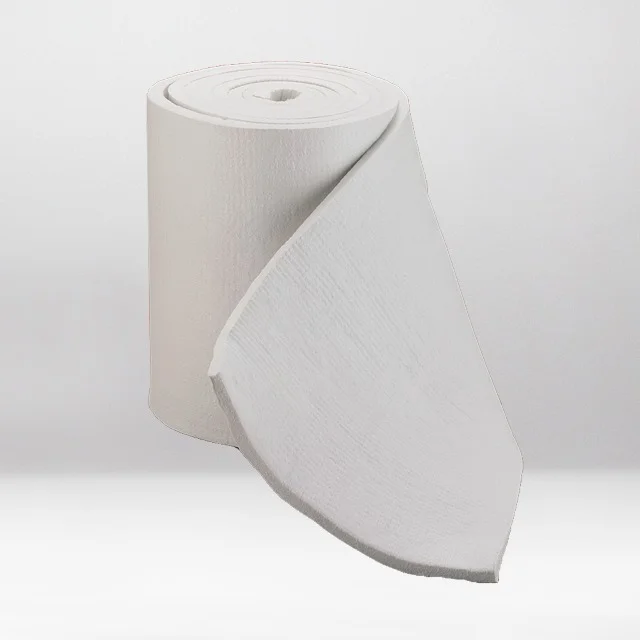
Ceramic Fiber ISOWOOL
Imported from Japan Isolite Insulating Products Co., Ltd., Japan.
Companies That Trust Our Ceramic Fiber